The production intelligence behind every phase of making.
From the first enquiry to the monthly review, ASTR Production AI plans, engineers, costs, schedules, tracks, inspects and maintains — generating recipes, BOMs, work orders and job cards from one prompt, and predicting breakdowns before they stop the line.
Process sequence, parameters, stages and checkpoints.
Waiting
STEP 3
Bill of materials
Sheet, tube, fasteners and powder per unit and per order.
Waiting
STEP 4
Costing
Material, labour, machine and overhead cost per rack.
Waiting
STEP 5
Production plan
Capacity-checked schedule against the due date.
Waiting
STEP 6
Work orders
One per stage — cutting, bending, welding, coating.
Waiting
STEP 7
Job cards
Operator instructions with quality checks per machine.
Waiting
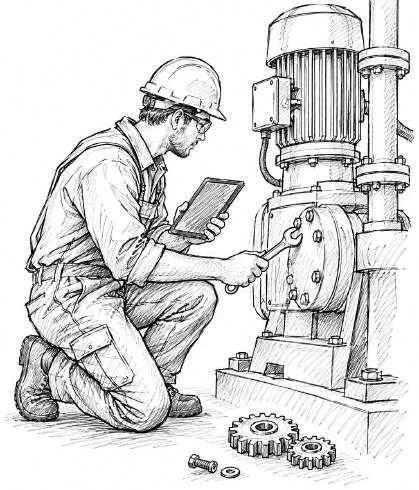
Machine maintenance intelligence
From fixing breakdowns to predicting them.
ASTR combines OEM specifications, your maintenance history and live machine signals to move every machine up the maintenance ladder — one step at a time.
LEVEL 1Reactive
Breakdown maintenance
Fix it when it fails — but at least know what failed, why and how long it took.
HOW ASTR DOES IT
Breakdown tickets from the operator app
Downtime reason and duration captured
Repeat-failure detection
Needs: Operator app
LEVEL 2Planned
Preventive maintenance
Service machines on a schedule based on the manufacturer’s intervals.
HOW ASTR DOES IT
OEM intervals by hours, cycles or calendar
PM tasks and checklists per machine
Maintenance windows planned around production
Needs: OEM data + schedule
LEVEL 3Monitored
Condition-based
Service when the machine says it needs it — not before, not after.
HOW ASTR DOES IT
Live signals from PLCs and sensors
Alerts when readings leave OEM ranges
Tickets raised automatically
Needs: PLC or sensors
LEVEL 4AI
Predictive maintenance
See failure coming days ahead from how signals are trending.
HOW ASTR DOES IT
Trend and pattern detection on signals
Likely cause and remaining time estimate
Best window chosen from the schedule
Needs: Signal history
What happens when a machine starts to drift
01
Detect
A signal drifts or an operator reports a fault.
02
Diagnose
ASTR compares with OEM limits and past failures.
03
Raise ticket
Ticket opened with machine, cause and priority.
04
Plan
Spares reserved, technician and window assigned.
05
Fix
Work done with OEM checklist on mobile.
06
Verify
Machine signals confirm it’s back in range.
07
Learn
Failure history improves the next prediction.
Signals ASTR watches
Vibration
Bearing wear, imbalance, misalignment, looseness.
Temperature
Overheating motors, spindles, hydraulics and bearings.
Motor current
Overload, tool wear, mechanical binding.
Pressure
Leaks, pump wear, blocked filters in hydraulics and pneumatics.
Cycle-time drift
Slowing mechanisms, tooling and process issues.
Oil & lubrication
Contamination and lubrication intervals.
Energy draw
Inefficiency and abnormal load per unit.
Alarm frequency
Recurring PLC alarms that signal a bigger fault.
Machine health · example
CNC-04
Service in 3 days
14 days agoVibration (mm/s) vs OEM limit 4.5Today
Likely cause
Bearing wear
Spare in stock
Yes · 2
Best window
Thu, shift C
ASTR: Schedule bearing replacement on Thursday night shift. Move job WO-2231 to CNC-02 to protect Friday’s delivery.
OEM intelligence built in
Manufacturer, model and serial for every machine
Operating ranges for speed, load, temperature and pressure
Service intervals by hours, cycles or calendar
Spare part lists and exploded views
Manuals and troubleshooting guides, searchable by ASTR
Spares, AMC & technicians
Critical spares and minimum stock per machine
Spare issue against every maintenance ticket
AMC, warranty and vendor service visits
Technician skills, assignments and response time
Maintenance cost per machine and per hour run
Maintenance KPIs, explained
MTBF
— average running time between failures.
MTTR
— average time to repair and restart.
Availability
— share of planned time the machine could run.
PM compliance
— preventive tasks done on time.
Repeat failures
— the same fault returning within a period.
Cost per machine
— parts, labour and AMC per machine-hour.
EXAMPLE ALERTS
CNC-04 · Line 2Predictive
Spindle vibration trending towards OEM limit
Likely bearing wear. Ticket MT-219 opened; job WO-2231 moved to CNC-02.
PRS-01 · Line 1Condition
Hydraulic oil temperature above range
Check cooler and filter before the next shift. Spare filter reserved.
OVN-02 · CoatingPreventive
Burner inspection due in 2 days
Per OEM interval. Planned in Thursday’s low-load window.
Production insights
Not just what happened. Why — and what to do next.
Loss analysis
Availability, performance and quality losses by machine and shift.
Bottlenecks
The stage that limits output today — and next week.
Yield & scrap
Where material is lost, by product, stage and operator.
Cost variance
Estimated versus actual cost by order and product.
Energy per unit
Power consumed for every unit produced.
Schedule adherence
Plan versus actual, and why it slipped.
Shift & operator
Output, quality and downtime by team.
Material consumption
Actual use against BOM norms.
ASTR insight feedExample insights
LossLine 2 · this week
Changeovers between 2 pm and 4 pm take twice the standard time.
→ Group similar SKUs on the afternoon shift; pre-stage dies.
BottleneckWelding cell
Welding is running at full load while bending waits half the shift.
→ Move 2 jobs to the second welding cell on night shift.
CostOrder SO-1182
Actual powder consumption is above the BOM norm for this rack.
→ Check gun calibration; update norm after 3 batches.
QualityShelf panels
Most bend-angle rejections come from one die set.
→ Schedule die inspection before the next batch.
EnergyOven-02
Energy per rack is higher when the oven runs half-loaded.
→ Batch coating jobs to run the oven fully loaded.
Core manufacturing capabilities
Beyond Machines. Understanding the Entire Manufacturing System.
Maintenance requirements and lifecycle information.
OEE (Overall Equipment Effectiveness)
Availability of scheduled production time.
Performance against expected speed.
Quality of output against requirements.
Production losses and improvement opportunities.
Production Performance Intelligence
Production output and target tracking.
Cycle time and throughput analysis.
Machine and process efficiency.
Bottleneck identification and production variance.
Automated Recipe Building
Product specifications and production requirements.
Materials, quantities and process sequences.
Equipment, stages and operating parameters.
Quality checkpoints and acceptance criteria.
BOM (Bill of Materials) Intelligence
Product component identification.
Raw material and quantity calculations.
Component specifications and dependencies.
Material requirements and consumption planning.
Intelligent Manufacturing Costing
Raw material and component costs.
Labour and machine operating costs.
Process and overhead costs.
Cost comparison and variance analysis.
Quality Intelligence
Specifications and inspection parameters.
In-process and final quality checks.
Defect identification and rejection tracking.
Process deviations and corrective actions.
Run production with intelligence.
Smart BOM
Materials
Material requirements calculated from the recipe, with stock and shortages shown before you plan.
Intelligent Costing
Costing
Cost per unit and per order, with margin against the quoted price.
Quality Intelligence
Inspections
Checks attached to each stage; failures raise deviations and corrective actions.
Production Planning
Plans
Plans that respect machine capacity, material availability and due dates.
Collective > Individual
An operator understands their machine. An engineer understands their design. A quality team understands inspection. ASTR gives each of them their own view — on the same data.
Operator
Operator app at the machine
Sees today’s job cards and drawings
Records output, scrap and downtime reason
Raises a breakdown in one tap
Follows parameter and quality checks
Supervisor
Tablet on the floor
Assigns jobs and operators
Watches line progress live
Approves material issue
Escalates delays
Planner
Desktop
Builds and re-plans schedules
Checks material readiness
Tests urgent-order impact
Balances machine load
Engineer
Desktop
Generates and approves recipes
Manages drawings and revisions
Sets standard times
Reviews cost sheets
Quality
Tablet & desktop
Runs stage inspections
Holds and releases lots
Closes deviations and CAPAs
Traces defects to cause
Maintenance
Mobile
Receives tickets and alerts
Follows OEM checklists
Issues spares
Confirms machine back in range
Plant head
Any device
Sees OEE and losses
Asks ASTR any question
Reviews cost variance
Tracks improvement actions
How We Build Your Production Intelligence.
We start by understanding your business from the ground up, analysing existing workflows, identifying challenges and uncovering opportunities for improvement. We then design the solution architecture, review it with your team, gather feedback and approvals, and only then move into engineering, implementation and continuous improvement.
1
Understand your business
Step 01 · Discover
We start from the ground up, learning how your business really works today.
2
Analyse workflows
Step 02 · Analyse
We study existing workflows, identify challenges and uncover opportunities for improvement.
3
Design the architecture
Step 03 · Design
We design the solution architecture around your requirements and processes.
4
Review & approve
Step 04 · Align
We review the design with your team, gather feedback and get approval before we build.
5
Engineer & implement
Step 05 · Build
Development, integration, testing, deployment and onboarding.
6
Improve continuously
Step 06 · Evolve
We keep refining the solution as your operations and requirements evolve.
We don't build first and understand later. We understand first, design together and build what your business actually needs.